
VR Design System:
Immersive Cleanroom
Overview
We were tasked with developing a immersive VR cleanroom to help pharmaceutical and biotech stakeholders visualize laboratory environments beyond traditional engineering drawings and 3D models. Users could navigate the facility at full scale, interact with key equipment and systems, and gain a deeper understanding of cleanroom workflows, material handling processes, and overall facility design before implementation.
Company: GMP Engineering Inc
Role: VR Developer
Platform: VR (Quest 2)
Tools: Unity, C#, Final IK, Realtime Normcore, Maya
Challenge
Pharmaceutical cleanrooms are often communicated through CAD models, floorplans, and engineering documentation, making it difficult to understand how equipment, personnel, and processes work together at full scale.
The challenge was to create an immersive VR environment that allowed stakeholders to experience gowning, decontamination, isolator access, and sterile material handling within the context of a complete operational workflow.
My Contributions:
CAD Asset Preparation
-
Prepared engineering CAD assets for use within Unity-based VR environments.
-
Organized large CAD datasets into manageable scene components in Maya to support development workflows.
-
Reduced and refined model complexity while preserving the visual detail necessary for stakeholder reviews.
-
Balanced performance and visual fidelity to ensure assets remained suitable for real-time interaction.
Interaction Framework
-
Designed and implemented a reusable interaction framework to support multi-step procedural workflows across cleanroom environments.
-
Enabled consistent handling of complex operations such as material transfer, equipment interaction, and sequential task execution within a unified system architecture.
Character Systems
-
Developed a user profile and setup system to support role-based scene entry and configuration.
-
Integrated runtime rigging and full-body alignment using Final IK to ensure accurate spatial grounding and improve embodiment within the VR environment.
Immersion Features
-
Built dynamic hand-pose and object interaction systems to support realistic grasping, manipulation, and procedural handling of equipment.
-
Improved physical feedback and user presence during critical cleanroom workflows, enhancing overall immersion and task clarity.
Entry Protocol
-
Developed a gowning workflow to simulate the controlled entry procedures required for cleanroom access.
-
Designed interactive equipment and garment handling to support procedural understanding while maintaining an intuitive user experience.
-
Helped stakeholders visualize the relationship between personnel preparation and overall cleanroom operations within the facility.
Contamination Control
-
Developed an interactive misting shower sequence to simulate decontamination procedures between controlled environments.
-
Helped stakeholders visualize how contamination mitigation measures are incorporated into facility design and day-to-day operations.
Project Evolution
1. Initial State & System Inheritance
The environment required significant stabilization before development could begin.
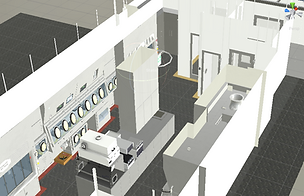
Lighting was slightly misconfigured, washing out wall colors and muting floor materials, reducing overall visual clarity. The character system was a basic placeholder model with no defined anatomy, limiting scale and presence. The project also contained multiple repository and runtime errors that prevented normal development.
Lighting: Before
Character: Before

Lighting: After

Character: After

2. Stabilization
Resolved project and runtime issues to establish a stable, working baseline for development.
This ensured all systems could run reliably before interaction work began.
3. Task-Based Development
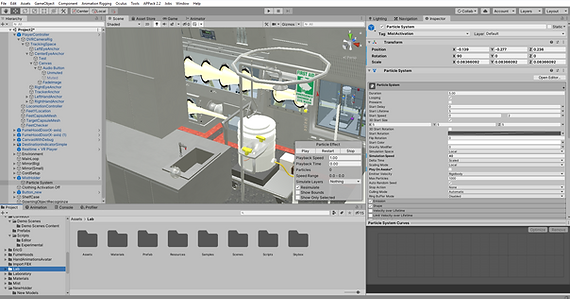
Work was assigned through daily or next-day meetings, with tasks varying by complexity.
Existing interaction patterns were reused when available, otherwise systems were built from scratch.
4. Interaction Design Approach
New interactions began with research into real-world pharmaceutical procedures.
Each system was broken down into core elements such as object states, user inputs, and step logic before implementation.
Research
Study real-world procedures
Breakdown
Identify core elements
Design
Define logic, inputs, states
Implement
Build and integrate in Unity
5. Rapid Prototyping & Iteration
Interactions were built as functional prototypes first, aiming for same-day validation when possible.
This enabled fast iteration and continuous improvement across systems.
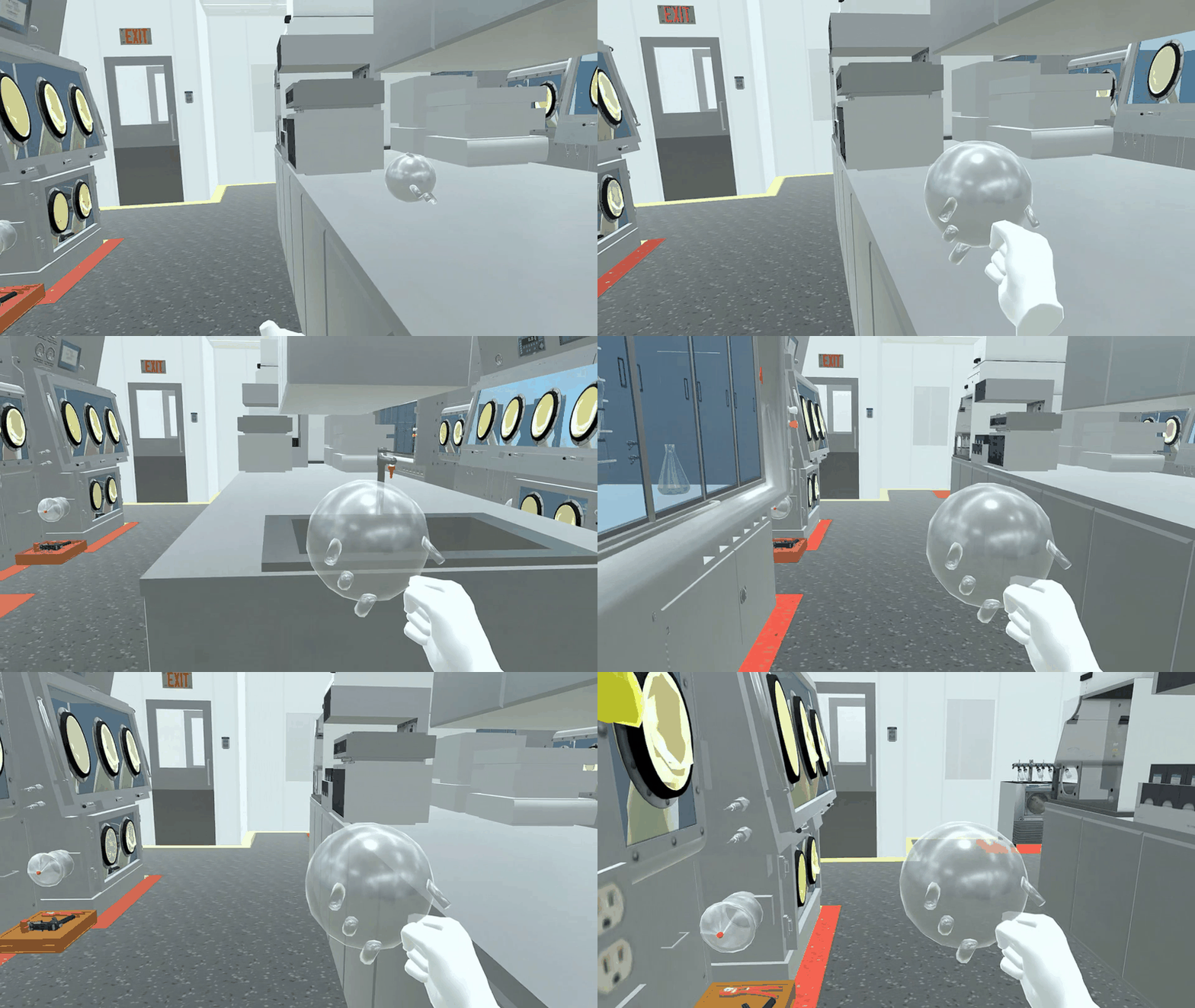
The old flask grab had some "jittering" issues when the user would move around and wouldn't quite stay with the hand. Based on user feedback, this would cause the scene itself to feel "laggy" and "incomplete."
Outcome
-
Transformed engineering documentation into an immersive, full-scale VR experience.
-
Enabled stakeholders to explore facility layouts, workflows, and equipment interactions in context.
-
Improved understanding of cleanroom operations beyond traditional CAD models and floorplans.
-
Created a reusable foundation for future pharmaceutical visualization experiences.
Reflection
-
Research-driven interaction design
-
Building reusable interaction systems
-
Translating technical workflows into immersive experiences
-
Balancing visual fidelity with VR performance